Professional and Organizational Development = POD
It would be easy to get overwhelmed just by picking sessions for this conference. POD was my first time attending an event purely based on faculty development and it definitely didn’t disappoint. This year it was held in Portland, OR and ran morning to night over the course of 5 days.
I wanted find a way to reflect on the lessons learned and notable sessions I attended while at POD, and hopefully these insights will resonate with others.
One of the topics I am especially interested in is the area of well-being and all of its varied dimensions. I studied this topic in graduate school and try to practice in my daily activities. My pre-conference activity was on “Creating a Culture of Well-Being” as part of a 3-hour interactive workshop. It was co-taught by Amber Young-Brice, Marquette University and James Fortney, St. Louis University, both faculty developers. We talked , a lot about how our role as faculty developers is so important to the creation of campus cultures that foster individual, community, and institutional well-being.
As my team works with faculty I will encourage them to think about the “Theory-Guided Dimensions of Well-Being”. How are we contributing to our faculty’s well-being, helping them find their own well-being? How are we contributing to our students well-being, helping them find their own?
Ryff, C.D. (1989). Happiness is everything, or is it? Explorations on the meaning of psychological well-being. Journal of Personality and Social Psychology, 57, 1069-1081.
Definitions of Theory-Guided Dimensions of Well-Being
Self-acceptance High scorer: Possesses a positive attitude toward the self; acknowledges and accepts multiple aspects of self including good and bad qualities; feels positive about past life. Low scorer: Feels dissatisfied with self; is disappointed with what has occurred in past life; is troubled about certain personal qualities; wishes to be different than what he or she is.
Positive relations with others High scorer Has warm, satisfying, trusting relationships with others; is concerned about the welfare of others; capable of strong empathy, affection, and intimacy; understands give and take of human relationships. Low scorer: Has few close, trusting relationships with others; finds it difficult to be warm, open, and concerned about others; is isolated and frustrated in interpersonal relationships; not willing to make compromises to sustain important ties with others.
Autonomy High scorer: Is self-determining and independent; able to resist social pressures to think and act in certain ways; regulates behavior from within; evaluates self by personal standards. Low scorer: Is concerned about the expectations and evaluations of others; relies on judgments of others to make important decisions; conforms to social pressures to think and act in certain ways.
Environmental mastery High scorer Has a sense of mastery and competence in managing the environment; controls complex array of external activities; makes effective use of surrounding opportunities; able to choose or create contexts suitable to personal needs and values. Low scorer: Has difficulty managing everyday affairs; feels unable to change or improve surrounding context; is unaware of surrounding opportunities; lacks sense of control over external world.
Purpose in life High scorer: Has goals in life and a sense of directedness; feels there is meaning to present and past life; holds beliefs that give life purpose; has aims and objectives for living. Low scorer: Lacks a sense of meaning in life; has few goals or aims, lacks sense of direction; does not see purpose of past life; has no outlook or beliefs that give life meaning.
Personal growth High scorer: Has a feeling of continued development; sees self as growing and expanding; is open to new experiences; has sense of realizing his or her potential; sees improvement in self and behavior over time; is changing in ways that reflect more self-knowledge and effectiveness. Low scorer: Has a sense of personal stagnation; lacks sense of improvement or expansion over time; feels bored and uninterested with life; feels unable to develop new attitudes or behaviors
Another notable session I attended was by Jason Fizsimmons, Karen Neubauer, and Amy Watson from Purdue University on “Blurred Lines: Expanding Faculty Development Capacity Through Cross-Unit Collaborations”
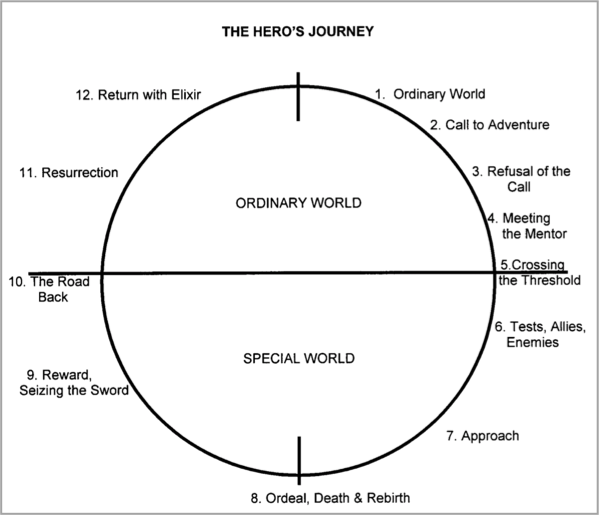
This session was especially relevant to the organizational development work being done here in the Teaching and Learning Collaborative, and actually any place where a new path is being forged and buy-in is necessary for constituents. The Hero’s Journey is essentially a story of change management and maybe even of a change in culture. The facilitators had us pick a scenario happening in real-life work, and run through all of the stages of the Hero’s Journey to see how we could potentially manage any terrain along the way. It was an incredibly helpful exercise and I plan to follow up with Karen and maybe work through this chart with our team in the TLC.
All in all, it was a great experience. I met SO many incredible people and extended my network of future collaborators. I had the opportunity to chat with so many others in the midst of their own LMS review and picked up quite a few tricks and tips that will really help our process. I do hope to return to POD some day as it was an incredibly fruitful experience.